Pages

samedi 23 janvier 2021

BENDA ET MENCKEN


Julien Benda and H.L.Mencken : a parallel (*)


    Comparative history of ideas, like comparative literature, is a difficult exercise, because ideas always come within specific contexts and are expressed in idiosyncratic styles. On the one hand, everything can be compared with everything – teapots with rifles, Corneille with Tarantino, the last of the Mohicans with the last of the Valerii. On the other hand very often one does not see anything to be compared, in spite of superficial similarities. I want to compare briefly the doctrines and the characters of two intellectuals of the same generation, one French, the other American, Julien Benda and Henry Louis Mencken. Each of them has incarnated, in his own country, a certain “style of idea”, to borrow the title of one of Benda’s books (le style d’idées), which I shall try to describe as a form of angry rationalism or as a cold satire of their times.

    Julien Benda and H.L. Mencken were near contemporaries: the first was born in 1867, the second in 1880, and they both died in 1956. Both were famous in their respective countries between the two wars; both are today mostly forgotten, apart for some slogans, such as Benda’s famous title “ the betrayal of intellectuals”, and  Mencken’s coinage of terms like “booboisie” and his numerous witticisms[1]. Both were great polemicists, who adopted the tone of rogues and curmudgeons, and they both achieved the status of the most hated intellectuals of their days. Both seemed to be always angry at their compatriots and at the whole world. Both liked the posture of enfants terribles. Apart from that, they seem to have little in common. The one is probably the last representative of Franco-judeism, a defender of classicism and of intellectual values, who became during the 1930 one the best spokesmen of democracy in France, but who ended his political career as a communist. The other is an American, known for his distrust of democracy and his individualism, his scorn for European classicism and his apology of popular American culture, and some of his racist comments on blacks and jews have not been unnoticed.

     In spite of the huge difference in their contexts, Benda and Mencken have a similar mindset. I shall first give separately their portraits, in the style of Plutarch, then compare and contrast.

     Let us start with Julien Benda. As he tells us in his autobiography, La jeunesse d’un clerc (1936), he was born, like Proust, his near contemporary, in a well-integrated family of the jewish bourgeoisie, fully republican and patriotic, and went to Lycée Charlemagne. There he studied mathematics and tried to enter the Ecole polytechnique, failed and went to Ecole Centrale, from which he quickly resigned, because he could not stand the practical orientation of teaching. He then studied history at the Sorbonne, psychology with Ribot at the College de France, and self-trained himself in scientific matters. The first great momentum of his life was the Dreyfus affair, which he calls "a palladium of history". He fully embraced the cause of the dreyfusards, although he distanced himself from the “dreyfusisme larmoyant “ (whimpering dreyfusism) and wrote in Revue blanche, the most progressive journal of the time in France, articles which he will in 1900 bring out in a book Dialogues à Byzance. During this period, he befriended  Charles Péguy, and became a regular contributor of the Cahiers de la Quinzaine, but soon expressed strong dissent from Péguy’s admiration of Bergson, whom he took to be an “Alexandrian jew”, hostile to reason and logic (in contrast with Hebrews, supposed to be lovers of reason and logic). In the Cahiers, in 1910, he published Mon premier testament, a rather Nietzschean book, and in 1912 a polemics against Bergson, Une philosophie pathétique, soon followed by two other books against a philosopher whom he took to be the main purveyor of irrationalism. Bergson was to be his bête noire throughout his life. In the wake of his first essays, he wrote in 1918 his first successful book, Belphégor, where he derides the leisure class society (the very one which Thorstein Veblen had described a few years before, although there is no evidence that he knew Veblen’s work) and the aestheticism of his age. His defense of a classical aesthetics in this book and others that he published during the first world war gave him a reputation of being a kind of reactionary classicist, on par with the kind of rejection of romanticism that was then both pervasive in French culture from different corners : from Charles Maurras and Action française on the one hand, and from the NRF  of Gide, Rivière and Paulhan on the other.  Benda, however, never expressed any attraction for Action française. On the contrary, he was to become, during the 1920, one of the main opponents to what Zev Sternhell has called the French branch of fascism. His conversion to left wing politics was slow. During the first-world war, he started writing in Le Figaro, and published a series of articles defending Union sacrée. He opposed strongly pacifists such as Romain Rolland, arguing that German literature, history and philosophy was directly responsible for the advent of the war. He would later express his anti-German attitude during the thirties, and because of it, become one of the every early attackers of Nazism in France. His evolving reflections on nationalism, on Nietzsche, and on Action française prompted him to write both against intellectuals of the French right and of the French left, in a book which was an instant best seller in 1927, La trahison des clercs. In this book he accused all “clerics” – a category embracing all kinds of “intellectuals” - to have abandoned their traditional ideals of truth, justice and freedom of thought, to embrace timely politics and to flatter the passions of the crowds. At the same moment, Ortega y Gasset was warning his compatriots against the rebellion of the masses, and Kraus was fighting the populists in Austria. But Benda’s style was different. He sided for a form of renewed universalism which borrowed elements from French rationalism, from Christianism and from the French revolution. This conservative stance opened to him the gates of the NRF, and he became, during the 1930s one of the main pillars of the journal directed by Jean Paulhan, opposing the right wingv of the revue  represented by Drieu la Rochelle and the “social fascists”, such as Ramon Fernandez. He also wrote for many newspapers, signed a lot of petitions, went to demonstrations, although he was already in his old age. It can be said that during this period, he became, even more than Zola or Lucien Herr, one of the paradigms of what was later to be called the “intellectuel engage”. He fought both right (Action française and fascists) and left (Marxists such as Paul Nizan and Jean Guéhenno). He was everywhere where democracy was to be defended, and in consequence, was hated both as a jew and as a maverick leftist. In 1933, he advocated with enthusiasm the idea of a European Nation, and at the same time prefaced the very first book on Hitler, by Konrad Haiden. When the war broke out, in 1940, André Gide expelled him from the Nouvelle revue française, and he had to flee to the South of France, escaping shortly from the Gestapo, who destroyed his flat and burnt all his papers. He spent the war in Carcassonne and in Toulouse, hidden by the resistance and the communists. In his autobiography Exercice d’un enterré vif , he tells us that these were  the best moments of his life, since he was alone in his hotel room as in cell, with no other occupation than to write. At the Libération he reappeared with four manuscripts, and especially with La france byzantine, a charge against what he called “literaturism” or the French cult of literature, which he saw incarnated by Mallarmé, Valéry, Proust, Gide and Paulhan among others. However, he could never recover the place that he  had occupied on the pre-war intellectual scene. His positions about the épuration led him to be closer to the communists, and his post-war career were that of a fellow traveller of the communist party. His attitude during the Rajk trial in 1948 showed that he had lost his pre-war lucidity. He died in 1956, and had predicted his own epitaph, which he took from Lamartine’s life of Saint Just : « Son cœur absent ne reprochait rien à sa conscience abstraite, et il mourut odieux et maudit sans se sentir coupable. » (“His absent heart  had nothing to reproach to his abstract conscience, and he died hated and damned without feeling the slightest guilt” ).

    Let us now cross the Atlantic. H.L.Mencken was a rather different type. He was born in Baltimore in 1880, and was to remain in this city throughout his life. The son of a German immigrant whose father had established a prosperous cigar factory, he smoked cigars from morning till night. After working three years in his father’s factory, he was hired as reporter at the Baltimore Herald, where he stayed seven years, to become editor, reporting on the Republican and the Democratic national conventions. From 1906 he became editor of the Baltimore sun, where he was  famous for his shockingly flippant and satirical editorials and where he found his tone, in particular against the institution of marriage and against puritanism. In 1908, he began his long career as a book reviewer, being hired by George Nathan in the most classy literary journal of the time, the Smart Set, and cooperated to a number of other newspapers. At the outbreak of the war, at the very time when Benda was attacking Germany in the Figaro, Mencken expressed his sympathy for Germany, which led him to travel to Berlin and meet the Kaiser.  In 1920 that he began his golden age as a journalist, epitomised by his famous coverage of the Scopes or “Monkey trial”, which opposed the Christian fundamentalist William Jennings Bryan to the liberal Clarence Darrow, the first lines of which I cannot resist to quote:

“Such obscenities as the forthcoming trial of the Tennessee evolutionist, if they serve no other purpose, at least call attention dramatically to the fact that enlightenment, among mankind, is very narrowly dispersed. It is common to assume that human progress affects everyone -- that even the dullest man, in these bright days, knows more than any man of, say, the Eighteenth Century, and is far more civilized. This assumption is quite erroneous. The men of the educated minority, no doubt, know more than their predecessors, and of some of them, perhaps, it may be said that they are more civilized -- though I should not like to be put to giving names -- but the great masses of men, even in this inspired republic, are precisely where the mob was at the dawn of history. They are ignorant, they are dishonest, they are cowardly, they are ignoble. They know little if anything that is worth knowing, and there is not the slightest sign of a natural desire among them to increase their knowledge.”[2]

  His “Monday articles” in the Sun and his chronicles in the American Mercury were widely syndicated and established both him and his paper as a national institution. Although he was famous for despising democracy, Mencken was a lifelong Democrat, but  his libertarian stance in regard to both civil liberties and economic principles soon caused him to consider Franklin D. Roosevelt as tyrant whose “planned economy” was nothing more than disguised socialism—and inefficient socialism. To the surprise of his friends and to all those who read his cynical comments on marriage and his book A defense of women, which defends women just as much as Bloy defends jews in Le salut par les juifs, Mencken in 1930, at the age of fifty, married Sara Haardt, a southern writer whom he had known since 1923, but she  died in 1935. He was politically relatively silent during the 40s, although this time he expressed disdain for Hitler. He suffered from a stroke in 1948, after having supported Truman, ceased to write and died in 1956.


    There are indeed strong differences between Benda and Mencken. Benda was a republican jew coming from the bourgeoisie, Mencken was an ordinary middle class American. Their attitudes towards language and classical culture differed. Benda speaks an elegant French and defended a classical aesthetics. His literary horizon stops at Chateaubriand and Hugo. He has no admiration for romanticism, Flaubert or Proust, and he seems to have never opened a book by Céline or Joyce, in spite of the fact that the first insulted copiously him in Bagatelles pour un massacre. Mencken on the contrary praised the American language, and wrote a classical book on it (The American Language, 1919), which is still authoritative.  Mencken was in literature a son of Mark Twain, and he defended and admired Theodor Dreiser and Sinclair Lewis. He was a truly committed intellectual, probably the most committed of his generation, although he always adopted the posture of the sceptic.  Benda, in contrast, incarnated in France for at least two decades the paradigm of the “cleric”, who speaks up in the name of reason and universal values, which he heralded in his Treason of the intellectuals. His views have often been misunderstood as a defense on non-commitment and of the ivory tower, and in this respect taken by one of his most faithful readers in the English speaking world, T.S. Eliot as close to those of the American Humanist Irving Babbit[3]. But actually Benda’s view was that intellectuals should go to politics when the eternal values of truth and justice are threatened, and by no means preached retirement from the public scene. This attitude is indeed the same as that of Gide, Sartre and other engagés French intellectuals like Foucault, except that the latter never pretended to serve eternal intellectual values or truth. On the contrary, many of them take these values to be relative, time bound, and mostly social.  Mencken, was, at least officially, a conservative libertarian, who hated Woodrow Wilson, and was admired by Ayn Rand. His attitude towards intellectuals and academics, in particular Thorstein Veblen and even the pragmatists  Peirce, James, and Dewey , was of scorn and of contempt.[4]


    There are, however, strong similarities between the two writers. Both were autodidacts. Mencken spent very little time at school, Benda spent more time in the academic system, but left it rather soon, and he did not have an Alma mater. Both found their ways as publicists, as journalists and as writers outside literary circles of their times. Benda published more than 2000 newspapers articles in his life[5]. Both started from Nietzsche. Benda’s early book, Mon premier testament, published in 1910, is a Nietzschean analysis of political passions, defending the view that people (in particular anti-Semites) have a basic passion, which they then cover with ideas. On the very same year, Mencken, who spoke an excellent German, published his Philosophy of Nietzsche, the first book on Nietzsche on the American scene, published a translation of The Antichrist , and he took most of his debunking style from Nietzsche. In their early comments on women, democracy, in their elitism and nihilism of their first period, Benda and Mencken have a lot in common. One of the main objections of Benda against Bergson was that he pleased women. Benda, however, soon rejected Nietzsche’s nihilism for a form of Platonism, and he became a true democrat. Mencken pretended to hate democracy, and his numerous quotes (in particular his Notes on Democracy of 1906 ) are grist to the libertarian mill, but he was, in practice a true democrat too, and a progressist, a defender or free speech, a secularist who fought against religion, fundamentalism, the Southerners ( although he married one!). There is little in common between Benda’s militant rationalist intellectualism and Mencken’s sceptical thoughts about human values, and between the former’s passion for metaphysics, and the rejection of theory, theology and any other science than empirical by the latter. Nevertheless, they both praise, against the sophistication of their contemporaries, the stance of common sense and enlightened reason, of what George Orwell later called “decency”. They are both devoted to truth. If they had lived in our century they would have been utterly unable to understand the notion of post-truth, or would have taken it as a surrogate for religion opening the door to tyranny.[6]

    Perhaps the heart of what they have in common is their attitude of irony, humour, even of sarcasm, towards their contemporaries but also towards life in general. Their basic passion is anger[7]. Both are anti-modern, in Antoine Compagnon’s sense: they vituperate passionately. They are both satirists, but in very different styles. Benda’s style s coldly ironical, almost icy, and expresses anger in a sanctimonious way, close, as Albert Thibaudet once remarked,  to the style of the Prophets of Israel, Jonas and Ezechiel. Mencken’s style in contrast is lampooning, offending, infuriated and infuriating.  Mencken’s satire is fully Swiftean, as witnessed by his famous hoax where he studies the history of the bathtub, written in the style of Swift’s modest proposal and of Kraus Grunbenhund hoaxes [8] Satire is often understood as expressing scepticism towards reason and values, as if the satirist were mocking these. But it is a gross mistake. The satirist is a moralist and a rationalist, who contemplates the evils of his times and refers to standards and norms which he takes to be real. He is a puritan, not in Mencken’s sense – who said that puritanism is “the fear that someone, somewhere, might have a good time” – but in the sense of a worshipper of reason and truth.


                                                                   Ange Scalpel


[1] Recently his prophecy about American democracy has been much  quoted: “As democracy is perfected, the office of president represents, more and more closely, the inner soul of the people. On some great and glorious day the plain folks of the land will reach their heart's desire at last and the White House will be adorned by a downright moron.”, in H.L. Mencken, On Politics: A Carnival of Buncombe, 1920

[3] see Dominic Rowland,”T. S. Eliot and the French Intelligence: Reading Julien Benda” ANQ: A Quarterly Journal of Short Articles, Notes and Reviews Vol. 13 , Iss. 4,2000, and an interesting comparison between Mencken and Babbit in James Seaton,  Cultural Conservatism, Political Liberalism: From Criticism to Cultural Studies, University of Michigan, Ann Arbor, 1996.

[4] For his hate of academics, see e.g what he says on Veblen’s “pretentious verbiage” , H. L. Mencken, Prejudices: First Series (New York, 1919), pp. 67-68, quoted by M. Black, “The prevalence of Humbug” Cornell University Press, 1983, and on Peirce (to his friends Charles Angloff) : "So you believe in that garbage, too—theories of knowledge, infinity, laws of probability. I can make no sense of it, and I don't believe you can either, and I don't think your god Peirce knew what he was talking about."

[5] The best pieces of his journalism in the Thirties have been collected in Précision , Gallimard 1937.

[6] Perhaps the Benda of today is Timothy Snyder, On tyranny , 2016

[7] cf C. Rawson , Swift’s angers, Cambridge, Cambridge University Press. The same could be said of Flannery O’ Connor. Anger indeed is compatible with many kinds of values. There are angry catholics (Bloy, Flannery O’ Connor), angry jews (Kraus, Benda), angry Anglicans (Swift), and angry atheists (Mencken).

[8]  An excerpt: “Bathtubs are so common today that it is almost impossible to imagine a world without them. They are familiar to nearly everyone in all incorporated towns; in most of the large cities it is unlawful to build a dwelling house without putting them in; even on the farm they have begun to come into use. And yet the first American bathtub was installed and dedicated so recently as December 20, 1842, and, for all I know to the contrary, it may still be in existence and in use.
       Curiously enough, the scene of its setting up was Cincinnati, then a squalid frontier town, and even today surely no leader in culture. But Cincinnati, in those days as in these, contained many enterprising merchants, and one of them was a man named Adam Thompson, a dealer in cotton and grain. Thompson shipped his grain by steamboat down the Ohio and Mississippi to New Orleans, and from there sent it to England in sailing vessels. This trade frequently took him to England, and in that country, during the '30s, he acquired the habit of bathing.” ("A Neglected Anniversary" New York Evening Mail, dec 28, 1917. Later Mencken wrote about this episode: “
The success of this idle hoax, done in time of war, when more serious writing was impossible, vastly astonished me. It was taken gravely by a great many other newspapers, and presently made its way into medical literature and into standard reference books. It had, of course, no truth in it whatsoever, and I more than once confessed publicly that it was only a jocosity ... Scarcely a month goes by that I do not find the substance of it reprinted, not as foolishness but as fact, and not only in newspapers but in official documents and other works of the highest pretensions.” (Mencken, H L (1982). A Mencken Chrestomathy. Vintage Books. p. 592).


 (cet  article , retrouvé dans les papiers d'Ange Scalpel est paru ici  


mardi 1 décembre 2020

Contrefactuels de Morgenbesser


Sydney Morgenbesser

       On ne cesse de nous asséner des contrefactuels que nous sommes supposés prendre pour argent comptant . Par exemple les commerçants qui subissent la crise du covid , ou les stations de ski qui doivent  fermer parce qu'il n'y a pas de neige, ou les viticulteurs qui perdent leur récolte suite à un coup de grêle, nous disent qu'ils ont un "manque à gagner". Autrement dit ils acceptent 

      (1) s'il n'y avait pas eu tel événement (covid, pas de neige, grêle) nous aurions gagné tant d'argent 

 Et ils déposent des demandes à l'Etat pour compenser ces catastrophes naturelles. La difficulté est : combien d'argent. Réponse : ce qu'ils auraient gagné s'il n'y avait pas eu la catastrophe. Mais cela suppose une régularité ou même une loi qui ne va pas de soi: d'autres événements, peut être non naturels, auraient pu altérer la récolte, le temps ou les recettes. Les revenus soumis au hasard ne peuvent pas donner lieu à des attentes déterministes.

        Autre exemple : on nous dit que nombre de morts du covid sont des gens qui seraient morts de toute façon , donc il n'y a pas lieu de prendre des précautions pour se prémunir du virus à leur sujet, ni de s'inquiéter de ceux qui pourraient en mourir puisqu' eux ne mourront pas de toute façon. Autrement dit, s'il n'y avait pas eu le virus , ceux qui seraient morts quand même sont les mêmes que ceux qui pourraient l'avoir, et ceux qui pourraient l'avoir ne mourraient pas de toute façon. Mais comment le savons nous? 

        Vous ratez votre avion. Vous apprenez qu'il s'est écrasé . "Si j'avais pris cet avion, je serais mort". 

        Sydney Morgenbesser avait une objection bien connue à la théorie contrefactuelle de la causalité: "Si je n'étais pas né, je ne serais pas mort" ( donc la cause de ma mort est ma naissance). 

        Mais il avait une objection plus spécifique à la théorie des contrefactuels de David Lewis (1973). 

    On parie qu'une pièce (non truquée) va tomber sur face; mais elle tombe sur pile. (1) "Si vous aviez parié sur pile, vous auriez gagné" . Selon l'analyse de Lewis, les contrefactuels sont vrais quand le conséquent est vrai dans les mondes possibles les plus proches de ceux de l'antécédent. Donc pour (1) les mondes les plus proches de l'antécédent sont ceux dans lesquels un petit  miracle fait que vous pariez sur pile au lieu de face. Mais le pari est causalement indépendant des événements. 

        Les cas Morgenbesser  semblent réfuter une théorie simple des contrefactuels : la théorie suppositionnelle, qui dit que le degré de croyance qu'on doit accorder à un contrefactuel de la forme "Si A etait arrivé B serait arrivé" ( où A a lieu avant B ) est la probabilité , à un temps antérieur où A était probable, de B  étant donné A Comme le dit Dorothy Edgington : 

" confidence in a counterfactual expresses the judgment that it was probable that В given A, at a time when A had non-zero probability, even if it no longer does; and even if you do not now have a high degree of belief in В given A. (Edgington "On conditionals, Mind 1995: 265) 

  La théorie suppositionnelle implique que votre degré de croyance rétrospectif en (1) devrait ne pas être de plus que 50%.  Et pourtant on admet (1) comme vrai, ou comme hautement probable. C'est contradictoire.

   Mais comme l'a noté Philipps ( "Morgenbesser cases and closet determinism". Analysis 2007) , l'exemple de Morgenbesser, tout comme celui des commerçants et de leur manque à gagner, suppose le déterminisme. Si on ne suppose pas un monde déterministe , le contrefactuel n'est pas vrai. Les commerçants n'ont aucune raison de supposer que de toutes façons il n'y aurait pas eu de crise, les vignerons qu'il n'y aurait pas eu de grêle, les malades qu'ils ne seraient pas morts du covid. 

     L'Etat n'a donc aucune subvention à leur verser. La vallée de la Roya aurait pu aussi bien subir un tremblement de terre. On aurait pu aussi bien avoir la peste plutôt que le covid, etc. CQFD. Le Ministère des Finances et les assureurs peuvent dormir tranquilles. 


samedi 14 novembre 2020

Dictionnaire des idées reçues sur la raison


Ce texte a été retrouvé dans les archives d'Ange Scalpel, après son décès inopiné. Il devait rejoindre le volume Manuel de survie rationaliste, qu'il n'a jamais publié, mais qu'un imposteur lui a volé et plagié éhontément.

Angela Cleps


Analytique (raison). Dissèque et dessèche tout, le réduisant à des petits atomes ignorant le liant des choses et le fait que tout est dans tout. Est la source de l’individualisme contemporain, donc du libéralisme.

Analytique (philosophie). Se prétend distincte de la « continentale », mais on ne voit pas la différence. La différence est la même que celle entre conduire une Toyota ou une Volvo. Est partout et nous envahit. N’existe pas.

Argument. Ne sert à rien, sinon à embrouiller l’adversaire par des ratiocinations inutiles (voir : raisonnement). Nietzsche disait : « Qu’ai-je à faire d’arguments ? » Ceux qui se vantent d’argumenter n’ont rien à dire ou brandissent leurs arguments comme des épouvantails. Le vrai travail philosophique n’est pas dans l’argument, mais dans la profondeur de la pensée et du questionnement.

Causes. On ne les connaît pas. Mieux vaut s’en passer. D’ailleurs la notion n’a pas cours dans les sciences depuis Galilée.

Certitude. Il n’y en a pas. Plus on apprend plus on ne sait rien. Rien n’est ferme, tout est glissant.

Concept. Ecrase le particulier, la sensation, sous la généralité. Est vide sans l’intuition. Tonner contre : est, comme l’a dit Bergson, un vêtement trop large par rapport à la finesse de l’expérience. Devrait pouvoir être vague, souple, alors qu’il est une camisole de force pour la pensée. Philosophie du concept : hémiplégique, face à la philosophie de la conscience.

Contexte. L’essence des choses et de la connaissance. Tout dépend d’un contexte, est situé parce que mouvant, variable. Quand on connaît le contexte on peut juger, et éviter de se tromper en appliquant des principes rigides.

Décision.  Toujours arbitraire. Se prend sur un coup de tête. Doit être mûrement réfléchie. L’Etat, les institutions même reposent sur une décision arbitraire, comme l’ont montré Hobbes et Carl Schmitt.

Démonstration. Utile en mathématiques, mais absurde en philosophie : qui irait tout démontrer ?

Descartes.  Croyait qu’il suffisait de douter pour savoir avec certitude. Parti d’un bon pas, mais se perdit dans la forêt, même en marchant tout droit.

Dynamique. Tout ce qui est statique, fixe, figé est mauvais. Tout ce qui est dynamique, mouvant, changeant, est bon.

Esprit. Les Français en ont, peut être les Anglais, mais les Allemands n’en ont pas. De toutes manières Geist, Mind, spirito, ne peuvent pas vouloir dire la même chose que ce que ce terme signifie en français. Le vocabulaire des philosophes est intraduisible d’une langue dans une autre.

Existence. Précède toujours l’essence, qui est fixe, vous définit et vous opprime. Synonyme de liberté. S’éprouve, par un sentiment d’existence. Kant l’a dit : elle n’est pas un prédicat (on ne sait pas ce que cela veut dire). Il n’y a pas qu’une manière d’exister, mais de nombreux modes d’existence.  Une truelle n’existe pas comme un raton laveur, ni ce dernier comme un ciron. Tout est affaire de point de vue.

Fondement. Base de l’être et de la connaissance. Parfaitement illusoire et dangereux. Au service de la tyrannie. Seuls les totalitaires veulent fonder.  A un sens plus vulgaire, qu'on n'ose mentionner.

Heidegger Etait nazi. Mais quel grand penseur !

Histoire. Est finie. Manifeste la grandeur. En appeler à elle.

Ignorance. Asile. Vaut souvent mieux et rend plus heureux que le savoir.

Intellect. Pèse tout à l’aune de l’intelligence, au détriment de la vie et de l’intuition. On est toujours trop intellectuel. Il n’y a qu’à d’ailleurs regarder ceux qu’on nomme ainsi. Ils ne savent pas vivre, ni penser, car ils n’ont pas de corps.

Jugement. Acte du juge, activité judiciaire, qui trie, partage et condamne. Instrument du pouvoir, accompli au nom des concepts.

Logique. Sans cœur. Ou elle est mathématique, et inaccessible aux philosophes qui n’y entendent rien, ou elle est simplette, bonne pour les bébés, qui l’ont déjà. Dans les deux cas, elle est inutile. Pire, elle fait régner une véritable police de la pensée.

Mathématiques Les révérer. Tellement plus profondes que la logique ! Rares sont les philosophes qui les comprennent. Heureusement il y a Platon, Descartes, Leibniz, et Badiou.

Nécessité. Loi d’airain, déterminisme. S’oppose à la contingence, à la liberté. Toujours lui préférer cette dernière.

Norme. Instrument d’oppression. Nous impose ses règles, ses lois, ses contraintes.

Pensée. Heidegger nous a dit comment le faire : il faut s’ouvrir à l’être. Nietzsche aussi : on ne peut penser sans un corps.

Pragmatique. Adapté à l’action, à ce qui est pratique, utile à la vie et à la société. Souple, contre les principes rigides. Toujours à préférer à ce qui est théorique, qui ne sert à rien.

Principes. On est mieux sans qu’avec. Toujours préférer être un homme à paradoxes plutôt qu’un homme à principes. De toutes façons que fondent-ils ? (voir Fondement)

Progrès. On ne l’arrête ps. Nous impose ses normes, nous tyrannise avec la technique (nous arraisonne). Il n’y en a pas. Rien ne change. Tout était mieux avant.

Raison. Toujours froide, rigide et frigide, universelle. Empêche toute émotion, exclut toute passion. Totalitaire, fasciste, sectaire, intolérante. A Minerve glacée, préférer les belles latines chaudes et ardentes. Bon sens. Faculté universelle. Tout le monde l’a, et l’exerce. Pourquoi s’en targuer ?

Raisons. Le cœur a les siennes, que la raison ne connaît pas. Celle du plus fort est toujours la meilleure. L’espace des raisons, c’est comme le cercle de craie caucasien : une fois qu’on y est entré, plus moyen d’en sortir.

Raisonnement. Pure ratiocination. « Papa veut que je raisonne, comme une grande personne. Moi je dis que les bonbons valent mieux que la raison ». « Le raisonnement en bannit la raison » Les paranoïaques et les bureaucrates le pratiquent, mais la vraie pensée s’en affranchit.

Rationnel. Propriété de l’homme, selon Aristote. Mais l’est-il ? A-t-on besoin de l’être ? On l’est trop.

Rationalisme. Toujours étroit, étriqué. Veut de la raison partout, tout planifier, rendre tout certain. Doctrine impuissante et vaine.

Réel . On ne sait pas ce que c’est. Revient toujours à la même place. Autant l’appeler imaginaire. Il n’y en a pas.

Relatif.  Tout est relatif, dépend des circonstances et du contexte (voir contexte).

Savoir. Que sait-on ? Pas grand-chose. Et par quels critères ? Ceux qui prétendent savoir parlent toujours au nom du pouvoir et pour affermir leur domination et leur contrainte. Le savoir est toujours mouvant, contextuel, et passe de main en main. Est toujours l’instrument de la tyrannie. S’acquiert tout seul. Opprime les enfants à l’école, les patients à l’hopital, les citoyens face aux experts. Tout le monde sait, pourquoi y aurait-il des gens qui savent plus que d’autres. A la connaissance, qui demande la vérité et la vérification et qui est monotone, opposer les savoirs, pluriels, libres, créatifs.

Sceptique. Il faut l’être, car on n’a aucune certitude (voir certitude). Il ne faut pas l’être trop, car il faut bien vivre, on ne peut pas tout le temps s’abstenir de juger et d’agir.

Science. Sans conscience, elle n’est que ruine de l’âme. Bien plus amie de la religion qu’on ne le croit.

Tout fait. Se détourner de ce qui est tout fait et donné : idées, concepts, théories. Lui préférer ce qui est construit. On doit pouvoir évoluer, changer, professer (voir : Dynamique)

Universel. Toujours contre le particulier, oppressant. L’universel est tout fait. L’universel, il faut le faire. La raison cherche l’universel, contre la différence.

Vérité. Toujours bonne à dire. S’en méfier. Souvent préférable de la cacher et de mentir. Tous ceux qui s’en réclament ne la cherchent pas toujours, et même souvent la trahissent. Idéal creux et pompeux, brandi par ceux qui ont une conception obsolète de la science. Ne se réduit à pas grand-chose : quelle différence entre affirmer une chose et affirmer qu’elle est vraie ? Est toujours relative et particulière. Ceux qui se réclament d’une vérité universelle ne font que cacher leur volonté de puissance.

Vie. La seule vraie valeur, le seul vrai critère de vérité.

Wittgenstein. « Une régression de la philosophie, un système de terreur, la pauvreté instaurée en grandeur. » (Deleuze)

jeudi 15 octobre 2020

Un gardien de la raison


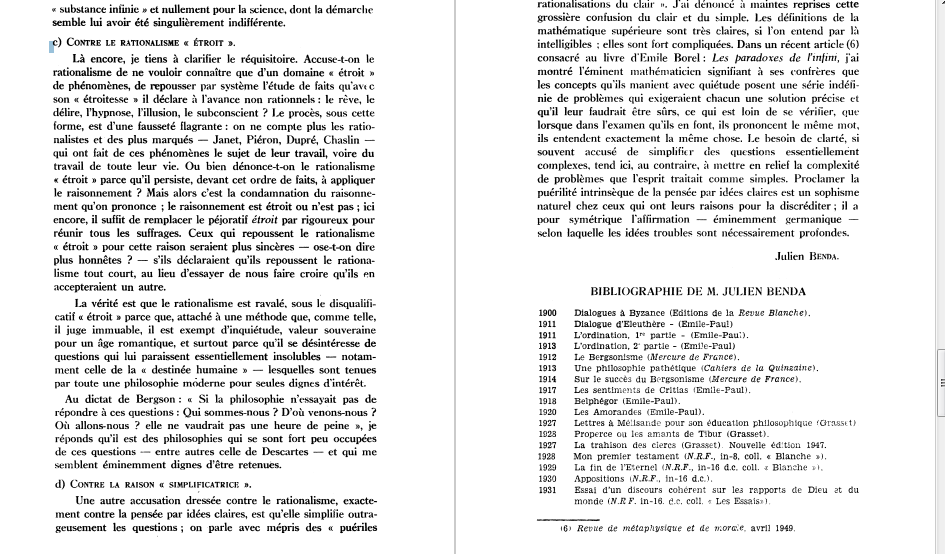
 En 1952, Benda publie  une sorte de testament, "Défense du rationalisme" (il ne cessait depuis 1914 de faire ses testaments, écrire d'outre ou d'infra-tombe) philosophique dans la revue de Gaston Berger, Les études philosophiques) ( cliquer sur les images ci dessous pour agrandir).

Il avait publié déjà plusieurs articles dans cette revue. Dans ces années il publiera aussi dans la Revue de métaphysique et de morale, et dans la Revue philosophique. Benda avait boudé, ou peut être échoué  à publier dans, ces revues philosophiques avant-guerre. Ses articles seront pour certains repris dans Quelques constantes de l'esprit humain. (1950). Hommage tardif des universitaires, qu'il s'était aliénés pour anti-bergsonisme? Ou refuge pour un has been  qui ne cessait de vilipender  les gloires du moment, Sartre, Merleau, Bachelard, Marcel, mais aussi les marxistes, alors même qu'il les rejoignait au Parti communiste? 


  Le rationalisme-t-il survécu ? 


lundi 21 septembre 2020

SNOBS

pas le  meilleur rôle de Lonsdale, mais l'un des meilleurs films de Mocky

     Quand je vis pour la première fois "Snobs" de Mocky ( dans un ciné club, cela passe rarement ou jamais à la télé), je ne compris rien, à part la dérision. Qu'y avait il de snob dans ces personnages désireux d'hériter  d'une laiterie de Granville qui rivalisaient de vilénies ? Quand on pense à un snob, on pense à des parisiens ou à des soirées à Saint Tropez chez Françoise Sagan ou Eddy Barclay. Et que venait faire , à côté de Francis Blanche, de Noel Roquevert et Jacques Dufilho le jeune Michel Lonsdale ( les obituaires récents ne se souviennent pas qu'il s'appelait "Michel" quand il faisait des films commerciaux ou des pantalonnades, et "Michael" quand il faisait des films sérieux) ? Mais malgré les apparences loufoques ( la scène de l'igloo est restée dans ma mémoire), Mocky est sérieux. Il déclara à propos de ce film (déclaration que l'auteur des Vices du savoir a reprise ) : "Un article démontra que tout le monde était snob: le boucher, le boxeur, le facteur. Tout dépend en fait de son attitude." Mais Mocky, qui ne se faisait pas appeler "mocky" pour rien, et Lonsdale, qui était anglais et avait des lettres, ont dû non seulement méditer cette phrase, mais aussi Thackeray, The book of Snobs

    Taine, dans son essai sur Thackeray repris dans ses Essais de critique et d'histoire, récemment republiés chez Garnier, caractérise fort bien son type de satire :


C'est de ce type d'ironie que procédait le jeu de Lonsdale. 


dimanche 13 septembre 2020

Ce bon David


David Hume Tower , university of Edinbugh


All news Equality, Diversity and Inclusion - an update

Equality, Diversity and Inclusion - an update

An update on the work of the University’s Equality & Diversity Committee and its Race Equality and Anti-Racist Sub-committee.


The work of the University’s Equality & Diversity Committee and its Race Equality and Anti-Racist Sub-committee has continued over the summer. It has been further energised following the killing in May of George Floyd and the ongoing campaigning by the Black Lives Matter movement. Our Race Equality and Anti-Racist Action Plan is accelerating and amplifying our efforts.


It is important that campuses, curricula and communities reflect both the University’s contemporary and historical diversity and engage with its institutional legacy across the world. For this reason the University has taken the decision to re-name – initially temporarily until a full review is completed – one of the buildings in the Central Area campus.


From the start of the new academic year the David Hume Tower will be known as 40 George Square.


The use of the building will also change: a shortage of study space because of the social distancing requirements means that the building is being re-purposed to provide additional student study space for 20/21.


The interim decision has been taken because of the sensitivities around asking students to use a building named after the 18th century philosopher whose comments on matters of race, though not uncommon at the time, rightly cause distress today.


This is ahead of the more detailed review of the University’s links to the past in the context of meaningful action and repair; this work is ongoing and is considering many other issues beyond the naming of buildings. It is a substantial exercise of research, engagement and reflection, upon which we will be able to adopt refreshed and appropriate policies on a range of issues such as the future naming of buildings as well as how we should commemorate our history more generally. The city of Edinburgh is also undertaking a similar review and the University is in discussions with the civic leaders about subjects which affect us both.

10 sept 2020 

      source : 

https://leiterreports.typepad.com/blog/2020/09/david-hume-has-now-been-cancelled-at-the-university-of-edinburgh.html

https://www.ed.ac.uk/news/students/2020/equality-diversity-and-inclusion-an-update


Rousseau avait bien raison de se défier de Hume


(Exposé succinct de la controverse qui s'st élévée entreM. Rousseau et M. Hume  Londres 1776  


mardi 25 août 2020

Waterloo désinterprété et réinterprété ( sur Philippe Mongin, Quinzaine littéraire 2011)


 en hommage à Philippe Mongin (1950-2020)


Grouchy 


Philippe Mongin, « Waterloo et les regards croisés de  l‘interprétation » in Alain Berthoz, Carlo Osola et Brian Stock , dir. La pluralité interprétative, fondements historiques et cognitifs de la notion de point de vue, Paris, Collège de France, 2010 , 223 p, hors commerce, disponible sur http://conferences-cdf.revues.org


      Quelle meilleure illustration des difficultés de l’interprétation des événements historiques, mais aussi de celles de l’interprétation en général, que la bataille de Waterloo ? Dans un essai formidable et passionnant[1], le philosophe et économiste Philippe Mongin revisite l’historiographie de ce pont aux ânes de la stratégie militaire et du récit historique. Il nous invite à reprendre à nouveaux frais les problèmes classiques de l’épistémologie de l’histoire et renouvelle avec brio une réflexion qui de Dilthey et Weber à Aron et Ricoeur, en passant par Hempel, Dray et Collingwood [2] n’a pas cessé d’occuper philosophes et historiens.


      Waterloo est une bataille d’interprétations. Il y a celle du Mémorial de Sainte Hélène, qui fixa la thèse officielle : Napoléon aurait pu vaincre successivement les Prussiens et les Anglo-hollandais, si Ney n’avait pas bougé trop tard et surtout si Grouchy n’avait failli à sa mission d’empêcher Blücher de rejoindre Wellington. Il y a celle de Clausewitz, dans sa Campagne de France en 1815, qui disculpe les officiers de  « Bonaparte »  et soutient que ce dernier avait multiplié les erreurs de commandement. Les inversions sémantiques sont légion en fonction des camps : pour les Français Waterloo est « la bataille du Mont Saint Jean », alors que pour les Anglo-Prussiens elle est celle de la « Belle alliance ». Aujourd’hui encore, le Français qui débarque à Londres peut s’écrier, comme Alphonse Allais: « Chez nous, toutes les rues portent des noms de victoires : Wagram, Austerlitz... Tandis que là-bas : Trafalgar Square, Waterloo Place... Ils n'ont choisi que des noms de défaites ! »   Les romantiques, Chateaubriand, Lamartine et Hugo en tête (« Grouchy ! » - C’était Blücher) consacrèrent le mythe, dans le sens napoléonien. Mais qu’il y ait deux points de vue, comme en tout conflit,  est chose naturelle. Stendhal inaugura une tout autre approche, qui allait elle aussi symboliser la situation interprétative : Fabrice à Waterloo n’a qu’une vision fragmentée, chaotique et secondaire des événements, comme  s’il n’y avait plus rien à interpréter ou comme si toute interprétation ne pouvait que refléter une  perspective irréductible aux autres.

     La question classique de l’épistémologie des sciences historiques consiste à savoir si celles-ci doivent s’appuyer sur un type d’explication causale ou sur une forme de compréhension herméneutique, ou pour reprendre la division courante depuis Wittgenstein, Anscombe et Davidson, si l’on a affaire à des causes ou à des raisons. Philippe Mongin montre que l’on peut classer l’ouvrage de Clausewitz sur la campagne de 1815 comme un prédécesseur des approches de ce que Weber appellera la rationalité instrumentale et comme un modèle de « récit analytique ». Clausewitz raisonne comme le ferait aujourd’hui un théoricien de la décision en attribuant aux agents des désirs et des croyances et en supposant qu’ils maximisent leur utilité espérée en situation d’incertitude et qu’ils sont des agents rationnels. Quel objectif poursuivait Napoléon en scindant en deux son armée pour en confier une partie à Grouchy ?  Il faut aussi, ce que ne fait pas toujours Clausewitz, raisonner en termes de théorie des jeux, et supposer que les agents, ayant atteint un nœud de décision associant un lieu géographique et un adversaire ( rencontrer l’ennemi à Quatre Bras, revenir vers Ligny) optent pour une stratégie donnée. Mongin reconstruit les stratégies en termes de théorie du choix rationnel et il ne se prive pas de faire des reconstructions rétrospectives, à la manière de ce que l’on appelle aujourd’hui le raisonnement contrefactuel en histoire : que se serait-il passé si… ? Si Napoléon n’avait pas envoyé Grouchy à la poursuite des Prussiens ? Si Grouchy était arrivé à temps ?

    Tout autre est le Waterloo de Stendhal. Le dialogue clef est celui de Fabrice et du Maréchal des logis : « Monsieur, c’est la première fois que j’assiste à la bataille, mais ceci est-il une véritable bataille ? – Un peu. » En prêtant à son héros ces interrogations, Stendhal manie l’ironie et introduit de la distance entre le sens commun, qui voudrait que les acteurs d’une bataille soient identifiés, que celle-ci ait un début et une fin, et la réalité fragmentaire perçue par son héros. Stendhal est un anti-théoricien des jeux : là où la théorie du choix rationnel découpe les événements en probabilités et conséquences, et les jugements en certains et incertains, le chapitre III de La Chartreuse nous montre un agent qui fait tout sauf maximiser son espérance mathématique.

    Il est tentant de voir dans les deux lectures, celle du philosophe de la guerre et celle du romancier, l’opposition entre l’explication rationaliste du récit analytique et la lecture herméneutique et compréhensive. Mais Clausewitz a parfaitement conscience des limites du modèle de la rationalité instrumentale. Il montre que les actions de Napoléon ne sont pas toutes rationnelles et que tout ne se laisse pas prédire par un calcul d’intérêt. On reproche le plus souvent aux modèles du choix rationnel, comme aux conceptions causales en histoire, de gommer la singularité des événements. Mais les deux ne sont pas incompatibles, comme l’a d’ailleurs montré Donald Davidson[3].  De son côté Stendhal incarne—t-il le modèle du récit herméneutique dans lequel le narrateur procède par empathie et reconstruit l’ « horizon » des significations des divers acteurs ? Pas plus. L’ironie stendhalienne suppose l’empathie de Stendhal pour son héros, mais aussi sa mise à distance[4].

     La notion d’interprétation est associée à au moins trois poncifs (bien représentés dans le volume dans lequel paraît l’article de Mongin, notamment dans un article de Barbara Cassin sur la relativité de la traduction) et qui composent ce que l’on peut appeler l’interprétationnisme.  Le premier est qu’à chaque interprétation correspond un point de vue exclusif des autres. Le second est le relativisme: toutes les interprétations se valent. Le troisième est que, selon le slogan nietzschéo-postmoderne, il n‘y a pas de faits, il n’y a que des interprétations.  Les lectures clausewitzienne et stendhalienne de Waterloo infirment ces trois poncifs. Tout d’abord il est faux qu’à chaque interprétation corresponde un point de vue. Aussi bien Clausewitz que Stendhal savent se placer de plusieurs points de vue à la fois. En second lieu il est faux que tous les points de vue se vaillent et que le pluralisme interprétatif règne. L’interprétation du Mémorial  ne tient pas devant l’historiographie et Stendhal démonte implicitement  la lecture romantique de la bataille. Il y a des interprétations meilleures que d’autres,  des points de vue plus objectifs que d’autres et si les modèles de la théorie du choix rationnel n’expliquent pas tout, ils permettent de tester des hypothèses. Enfin, le slogan nietzschéen tient-il la route ? L’interprétation est-elle seulement un récit parmi d’autres, le réel s’évanouissant derrière le conflit des interprétations qui le « construisent » ? Il y a certes un mythe de Waterloo, mais Waterloo n’est pas la guerre du Golfe selon Baudrillard : la bataille a eu lieu, et Clausewitz en donne un récit assez fidèle. On peut penser que Stendhal aussi. Certes son but est tout le contraire de celui de la description historique. Il ne vise pas la précision ou le détail, encore moins à faire vrai. Ce qu’il vise est la peinture des émotions humaines, ici celles qui se font jour dans une bataille. Il les décrit d’un certain point de vue, celui de Fabrice, mais ce qu’il décrit n’est pas moins réel. Stendhal aussi pratique l’histoire contrefactuelle : on peut lire tout le récit de Fabrice à Waterloo comme une expérience de pensée : que se passerait-il si on mettait un novice au milieu d’une bataille ? L’expérience de pensée n’est pas seulement œuvre d’imagination : elle peut être aussi au service de la recherche d’hypothèses sur le réel. L’interprétationnisme culmine dans la thèse selon laquelle l’histoire est un récit, tout comme la littérature, et n’est qu’un récit. Rendre à l’histoire et à la littérature leur statut de connaissances, c’est sonner la retraite de l’interprétationnisme et son Waterloo.

                                                                  Pascal Engel , Quinzaine littéraire 2011 


[1]   Relayé par un autre « Retour à Waterloo. Histoire militaire et théorie des jeux » , Annales. Histoire, Sciences Sociales 2008/1, 63e année, p. 39-69

[2] On se réfèrera toujours avec profit sur ces sujets au livre d’Alain Boyer L’Explication en Histoire , Presses Universitaires de Lille, 1992 .

[3] Actions et Evénéments , Paris, PUF 1993


von Blücher